Stock Price Volatility: The Overlooked Key to Successful Trading

Stock Price Volatility: The Overlooked Key to Successful Trading

Stock Price Volatility: The Overlooked Key to Successful Trading

Stock Price Volatility: The Overlooked Key to Successful Trading

Successful Trading Isn’t Just About Direction, It’s About Volatility

Successful Trading Isn’t Just About Direction, It’s About Volatility

Most trading strategies focus on predicting whether a stock will go up or down.
But the stock market doesn’t move in just two directions
It moves up, down, and sideways — and each of those movements creates opportunity.

A Trading System Built Around Volatility

The Tactical Trading System (TTS) was developed around a simple idea:

If volatility creates opportunity, a trading system should be designed to capture it.

Instead of trying to predict market direction, TTS focuses on price movement itself — the daily fluctuations that occur in every actively traded market.

Built on a mathematically defined framework refined through decades of real-world use, Tactical Trading converts stock price volatility into structured trading opportunities across stocks, ETFs, options, futures, and crypto.

No trend chasing.
No forecasting.
Just disciplined execution based on price and volatility.

Why Most Trading Strategies Struggle

Many traders rely on approaches that become fragile when market conditions change:

  • Market timing that rarely works when needed
  • Overcomplicated charts and lagging indicators
  • Emotional decision-making that leads to inconsistent results

These methods all depend on being right about direction.

But markets do not move in straight lines. They expand and contract, rise and fall, and constantly fluctuate with changing volatility.

The Tactical Trading Approach

Tactical Trading takes a different path.

Instead of predicting direction, the system focuses on managing position structure as prices move.

TTS provides a rules-based framework that defines:

  • Trade spacing based on volatility
  • Structured position management
  • Deterministic entries and exits
  • A process designed to operate across changing market conditions

This structure allows traders to capture opportunity from the normal movement of prices — movements that occur every day in active markets.

A Flexible Framework for Traders

Tactical Trading can be used as a standalone system or layered onto existing trading strategies.

Some traders use it with stock selection models.
Others apply it to ETFs, options, futures, or crypto markets.

The objective is simple:

Convert normal price movement into structured trading opportunity.

No guesswork.
No hype.
Just a defined mathematical process built around volatility.

Test it now — run your favorite stock through the free simulator →
14 - Day Free Trial, no card required
Get The Free Trial!
Tactical Trading - unique stock trading system
Tactical Trading Quick Backtest!
TTS Beats Buy and Hold: Enter Any Stock Symbol...

Click For Explainer

Get the proof! Enter any listed stock symbol then click "Confirm Symbol".
The backtest window will open, click "Start Sim" to compare Tactical Trading results to Buy and Hold.

You will be amazed by Tactical Trading's consistent out-performance.

Now Click =>
Start Sim
Buy or Sell Action:
Results Using Most Recent Three Months Of Price Data:
Tactical Trading % Return:
Buy Hold % Return:
TT Annualized % Return:
BH Annualized % Return:
Number Of Cycles:
Series:
Trade Range:
Shares Series:
Expected Profit Per Cycle:
Click Here to learn how the system works.
14 - Day Free Trial, no card required
Get The Free Trial!

Stock Price Volatility: The Overlooked Key to Successful Trading

Successful Trading Isn’t Just About Direction, It’s About Volatility

Most trading strategies focus on predicting whether a stock will go up or down.
But the stock market doesn’t move in just two directions
It moves up, down, and sideways — and each of those movements creates opportunity.

Stock Price Volatility: The Overlooked Key to Successful Trading

Successful Trading Isn’t Just About Direction, It’s About Volatility

Tired of strategies that collapse when markets shift? The Tactical Trading System (TTS) delivers consistent gains by trading price and volatility — not predictions or emotions.

Designed specifically for trading volatility, TTS uses a proven mathematical algorithm to capture profits from daily price movements in stocks, ETFs, options, futures, and crypto — no trend chasing, no forecasting, just data-driven execution.

While others struggle with:

  • Market timing that rarely works when needed
  • Overcomplicated charts and lagging indicators
  • Emotional trading that leads to inconsistent results

Tactical Trading empowers you with:

  • Automated entries and exits based on price and volatility
  • Profit potential in any market condition
  • Frequent gains from volatility most traders miss

Use TTS on its own or layer it over your current trading strategy. TTS delivers proven results by profiting from normal up-and-down price movements in stocks—with even better outcomes when using margin or applied to options and futures.

No guesswork. No hype. Just math that works.

Test it now — run your favorite stock through the free simulator →

14 - Day Free Trial,
no card required
Get The Free Trial!
Tactical Trading - unique stock trading system
Tactical Trading Quick Backtest!
TTS Beats Buy and Hold: Enter Any Stock Symbol...

Click For Explainer

Get the proof! Enter any listed stock symbol then click "Confirm Symbol".
The backtest window will open, click "Start Sim" to compare Tactical Trading results to Buy and Hold.

You will be amazed by Tactical Trading's consistent out-performance.

Now Click =>
Start Sim
Buy or Sell Action:
Results Using Most Recent Three Months Of Price Data:
Tactical Trading % Return:
Buy Hold % Return:
TT Annualized % Return:
BH Annualized % Return:
Number Of Cycles:
Series:
Trade Range:
Shares Series:
Expected Profit Per Cycle:
Click Here to learn how the system works.

Tactical Trading uses an exact mathematical algorithm that delivers
consistent results every time, not just a percentage of the time.

Tactical Trading uses an exact mathematical algorithm that delivers
consistent results every time, not just a percentage of the time.

Tactical Trading uses an exact mathematical algorithm that delivers
consistent results every time, not just a percentage of the time.

Leverages the normal daily trading range volatility through a unique, precise mathematical algorithm that's easy for anyone to understand.
The simple Tactical Trading algorithm provides precise buy and sell targets, delivering consistent and predictable profits with every trade cycle!
Tactical Trading always has two limit orders open: a buy and a sell. When one is filled, the system recalculates and specifies the prices for the next orders.
Tactical Trading is based on a powerful position management strategy that was first traded in 1990 and has been a closely held secret until now.
Leverages the normal daily trading range volatility through a unique, precise mathematical algorithm that's easy for anyone to understand.
The simple Tactical Trading algorithm provides precise buy and sell targets, delivering consistent and predictable profits with every trade cycle!
Tactical Trading always has two limit orders open: a buy and a sell. When one is filled, the system recalculates and specifies the prices for the next orders.
Tactical Trading is based on a powerful position management strategy that was first traded in 1990 and has been a closely held secret until now.
Leverages the normal daily trading range volatility through a unique, precise mathematical algorithm that's easy for anyone to understand.
The simple Tactical Trading algorithm provides precise buy and sell targets, delivering consistent and predictable profits with every trade cycle!
Tactical Trading always has two limit orders open: a buy and a sell. When one is filled, the system recalculates and specifies the prices for the next orders.
Tactical Trading is based on a powerful position management strategy that was first traded in 1990 and has been a closely held secret until now.

The Tactical Trading System includes features similar to dollar-cost averaging, swing trading, and trend analysis, offering surprising ease of use and powerful profit potential.

The Tactical Trading System includes features similar to dollar-cost averaging, swing trading, and trend analysis, offering surprising ease of use and powerful profit potential.

The Tactical Trading System includes features similar to dollar-cost averaging, swing trading, and trend analysis, offering surprising ease of use and powerful profit potential.

Completely documented with easy-to-follow tutorials designed to help you master the Tactical Trading System.
Trading parameters are simple to set up and can be adjusted anytime to optimize profits and manage risk effectively.
Excels in sideways chart patterns and can even generate profits during a moderate downtrend.
Instead of predicting the market, the system focuses on guiding traders in managing their positions effectively.
Unlike technical analysis, this system doesn’t analyze patterns or indicators—it simply focuses on volatility.
The Tactical Trading algorithm provides clear instructions on exactly when to buy and when to sell.
You’ll know the expected profit—our unique algorithm calculates your potential profit with precision before you enter your first trade.
Don’t just buy, hold, and hope—Tactical Trading has the potential to significantly boost your profits compared to a simple buy-and-hold strategy.
Completely documented with easy-to-follow tutorials designed to help you master the Tactical Trading System.
Trading parameters are simple to set up and can be adjusted anytime to optimize profits and manage risk effectively.
Excels in sideways chart patterns and can even generate profits during a moderate downtrend.
Instead of predicting the market, the system focuses on guiding traders in managing their positions effectively.
Unlike technical analysis, this system doesn’t analyze patterns or indicators—it simply focuses on volatility.
The Tactical Trading algorithm provides clear instructions on exactly when to buy and when to sell.
You’ll know the expected profit—our unique algorithm calculates your potential profit with precision before you enter your first trade.
Don’t just buy, hold, and hope—Tactical Trading has the potential to significantly boost your profits compared to a simple buy-and-hold strategy.
Completely documented with easy-to-follow tutorials designed to help you master the Tactical Trading System.
Trading parameters are simple to set up and can be adjusted anytime to optimize profits and manage risk effectively.
Excels in sideways chart patterns and can even generate profits during a moderate downtrend.
Instead of predicting the market, the system focuses on guiding traders in managing their positions effectively.
Unlike technical analysis, this system doesn’t analyze patterns or indicators—it simply focuses on volatility.
The Tactical Trading algorithm provides clear instructions on exactly when to buy and when to sell.
You’ll know the expected profit—our unique algorithm calculates your potential profit with precision before you enter your first trade.
Don’t just buy, hold, and hope—Tactical Trading has the potential to significantly boost your profits compared to a simple buy-and-hold strategy.

14 - Day Free Trial

Get The Free Trial!

Tactical Trading works on all stocks at all times, Here's how:

Tactical Trading works on all stocks at all times, Here's how:

Tactical Trading works on all stocks at all times, Here's how:

The core of the Tactical Trading System is the tempered martingale algorithm which provides an exact solution to a two-occurrence random walk, though randomness is not a requirement for Tactical Trading. The algorithm operates by manipulating a numerical series generally referred to as a "Cancellation System". While this example focuses on stock trades, the system is also effective for ETFs, options, futures, and crypto.

There are three main components to the Tactical Trading system: a numerical series called the "Cycle Series," a share multiplier known as the "Shares Per Series," and the "Trade Range," which is the dollar price move required to trigger a buy or sell order.

The core of the Tactical Trading System is the tempered martingale algorithm which provides an exact solution to a two-occurrence random walk, though randomness is not a requirement for Tactical Trading. The algorithm operates by manipulating a numerical series generally referred to as a "Cancellation System". While this example focuses on stock trades, the system is also effective for ETFs, options, futures, and crypto.

There are three main components to the Tactical Trading system: a numerical series called the "Cycle Series," a share multiplier known as the "Shares Per Series," and the "Trade Range," which is the dollar price move required to trigger a buy or sell order.

1) Choose a "Cycle Series" of numbers, such as 1,2,3,4. Any series of positive consecutive numbers will do. These numbers drive the system.
1, 2, 3, 4
2) Decide on the "Shares Per Series" number. It is used by the number series to calculate how many shares to own. It can be any positive number.
100
3) Using the included volatility analysis and simulation tools, determine the optimal price move, "Trade Range", required to trigger a buy or sell.
$1.00
1) Choose a "Cycle Series" of numbers, such as 1,2,3,4. Any series of positive consecutive numbers will do. These numbers drive the system.
1, 2, 3, 4
2) Decide on the "Shares Per Series" number. It is used by the number series to calculate how many shares to own. It can be any positive number.
100
3) Using the included volatility analysis and simulation tools, determine the optimal price move, "Trade Range", required to trigger a buy or sell.
$1.00
Click To See The Full Example >>
Close System Example
Click To See The Full Example >>
Close System Example
Click To See The Full Example >>
Close System Example
1) Choose a "Cycle Series" of numbers, such as 1,2,3,4. Any series of consecutive numbers will do. These numbers drive the system.
1, 2, 3, 4
2) Decide on the "Shares Per Series" number. It is used by the number series to calculate how many shares to own. It can be any positive number.
100
3) Using the included volatility analysis and simulation tools, determine the optimal price move, "Trade Range", required to trigger a buy or sell.
$1.00
The system predicts what the profit will be in advance of trading. This is calculated by summing the number series (1+2+3+4 = 10) multiplied by the shares per series (100), then multiplied by the trade range ($1).
10 x 100 x $1 = $1000
The number series, or "Cycle Series", tells you how many shares to own at any time. Get this by summing the two end numbers of the cycle series (1+4 = 5) and multiplying by the shares per series number.
5 x 100 = 500 shares
These numbers create what is called a "Cycle". This cycle starts by buying 500 shares. The cycle series is in control. If the stock moves up by the trade range ($1), a win, the system tells us to remove the two end numbers.
1, 2, 3, 4
If the stock moves down by the $1 trade range, a loss, the system sums the two end numbers of the cycle series (1+4 = 5) and adds that number to the end of the current series. This makes the new series:
1, 2, 3, 4, 5
When the stock moves up or down by the trade range this triggers an "action", a buy or sell order. You will know how many shares to buy or sell by summing the two end numbers and multiplying by the shares per series.
Let's trade a $10 stock
Using the cycle series 1, 2, 3, 4 we know to buy 500 shares. This is determined by summing the two end numbers ( 1 and 4) multiplied by the shares per series (SPS).
Buy 500 shares at $10
Cycle History
Action
Series
Shares Owned
Buy 500 at $10
1, 2, 3, 4
500
Now create two limit orders. Recall that the system knows if the stock has a win action (goes up by the $1 trade range) we cross off the series end numbers. 1, 2, 3, 4 becomes 2, 3. Sum the end numbers multiplied by the SPS.
WIN = Own 500 shares
We know that if the stock goes up by the $1 trade range the system wants us to own 500 shares. Since we already own 500 shares, the upper limit order becomes what is called a "No Action". If the stock moves from $10 to $11:
No Action (NA) at $11
If the stock moves down by the $1 trade range this creates a loss. When a loss occurs the system sums the series' two end numbers and adds that number to the end of the current series.
1, 2, 3, 4 => 1, 2, 3, 4, 5
With the new series of 1, 2, 3, 4, 5 if the stock moves down by the trade range we are to hold 600 shares (1 + 5) x 100. To get the loss order we subtract the current shares (500) from the required shares (600).
600 - 500 = 100
The downside limit order is to buy 100 shares. The current price of $10 minus the $1 trade range gives us an action price of $9. We place a "Good Until Cancelled" order to:
Buy 100 at $9 Limit GTC
Our $10 stock now has two actions corresponding to a "Win" and a "Loss". When the stock moves up or down by the trade range of $1 an action will occur and trigger an order, which are:

No Action (NA) at $11
Buy 100 at $9 Limit

The stock goes down by $1 to $9 and triggers our buy order and we must cancel the opposing order, No Action. The system now owns 600 shares. Since this action is a loss we sum the two end numbers and add the result to the end of the current cycle.
1, 2, 3, 4 => 1, 2, 3, 4, 5
Cycle History
Action
Series
Shares Owned

Buy 500 at $10
L - Buy 100 at $9

1, 2, 3, 4
1, 2, 3, 4, 5

500
600

The system now calculates the next two limit orders. The current series is 1, 2, 3, 4, 5. If the stock goes from $9 to $10 (win) we cross off the two end numbers and the new win series is:
2, 3, 4
If the stock moves down in price (loss) from $9 to $8 the system sums the two end numbers from the current series of 1, 2, 3, 4, 5 which is 6, and puts it a the end. The new loss series is:
1, 2, 3, 4, 5, 6
Now the system calculates the next two limit orders by summing the end numbers and multiplying by the SPS. This calculation tells us how many shares we should hold:

If Win Own 600
If Loss Own 700

We currently hold 600 shares and the last action was at $9. Therefore, the next limit orders are:

No Action (NA) at $10
Buy 100 at $8 Limit

The stock goes up by $1 from $9 to $10 and triggers our No Action order. The buy order is cancelled. The system still owns 600 shares. The win action causes the system to cross off the two end numbers from the current series:
1, 2, 3, 4, 5=> 2, 3, 4
Cycle History
Action
Series
Shares Owned

Buy 500 at $10
L - Buy 100 at $9
W - NA at $10

1, 2, 3, 4
1, 2, 3, 4, 5
2, 3, 4

500
600
600

The system now calculates the next two limit orders. The current series is 2, 3, 4. If the stock goes from $10 to $11 (win) we cross off the two end numbers and the new win series is:
3
If the stock moves down in price (loss) from $10 to $9 the system sums the two end numbers from the current series of 2, 3, 4 which is 6, and puts it a the end. The new loss series is:
2, 3, 4, 6
Again, the system calculates the next two limit orders by summing the end numbers and multiplying by the SPS. A single digit series counts as the end number. This calculation tells us how many shares we should hold:

If Win Own 300
If Loss Own 800

We currently hold 600 shares and the last action was at $10 so the next limit orders are:

Sell 300 at $11 Limit
Buy 200 at $9 Limit

The stock jumps up to $11 (win) and we sold 300 shares. The open buy order is cancelled and we now own 300 shares. The win tells the system to cross off the two end numbers. The current series is 3, the end number.
2, 3, 4 => 3
Cycle History
Action
Series
Shares Owned

Buy 500 at $10
L - Buy 100 at $9
W - NA at $10
W - Sell 300 at $11

1, 2, 3, 4
1, 2, 3, 4, 5
2, 3, 4
3

500
600
600
300

If the stock goes down from $11 to $10 (loss) the system sums the two end numbers (there is only one number left) from the current series of 3 which is 3, and puts it a the end. The new loss series is:
3, 3
Given the current series of 3 the system calculates the next two limit orders by summing the end numbers and multiplying by the SPS. This calculation tells us how many shares we should hold:

If Win Own 0
If Loss Own 600

We now hold 300 shares and the last action was at $11. If the stock goes to $12 the cycle series ends, so the next limit orders are:

Sell 300 at $12 Limit
Buy 300 at $11 Limit

Our stock makes a move up from $11 to $12 (win). The order to sell 300 shares is executed and we cancel the open order to buy. All series numbers have been crossed off,  and the cycle series ends.
All Numbers Cleared
Cycle History
Action
Series
Shares Owned
Cost
Balance

Buy 500 at $10
Buy 100 at $9
No Action at $10
Sell 300 at $11
Sell 300 at $12

1, 2, 3, 4
1, 2, 3, 4, 5
2, 3, 4
3
Cycle Ends

500
600
600
300
0

-5000
-900
0
+3300
+3600

-5000
-5900
-5900
-2600
+1000

The predicted profit of $1000 is realized
1) Choose a "Cycle Series" of numbers, such as 1,2,3,4. Any series of consecutive numbers will do. These numbers drive the system.
1, 2, 3, 4
2) Decide on the "Shares Per Series" number. It is used by the number series to calculate how many shares to own. It can be any positive number.
100
3) Using the included volatility analysis and simulation tools, determine the optimal price move, "Trade Range", required to trigger a buy or sell.
$1.00
The system predicts what the profit will be in advance of trading. This is calculated by summing the number series (1+2+3+4 = 10) multiplied by the shares per series (100), then multiplied by the trade range ($1).
10 x 100 x $1 = $1000
The number series, or "Cycle Series", tells you how many shares to own at any time. Get this by summing the two end numbers of the cycle series (1+4 = 5) and multiplying by the shares per series number.
5 x 100 = 500 shares
These numbers create what is called a "Cycle". This cycle starts by buying 500 shares. The cycle series is in control. If the stock moves up by the trade range ($1), a win, the system tells us to remove the two end numbers.
1, 2, 3, 4
If the stock moves down by the $1 trade range, a loss, the system sums the two end numbers of the cycle series (1+4 = 5) and adds that number to the end of the current series. This makes the new series:
1, 2, 3, 4, 5
When the stock moves up or down by the trade range this triggers an "action", a buy or sell order. You will know how many shares to buy or sell by summing the two end numbers and multiplying by the shares per series.
Let's trade a $10 stock
Using the cycle series 1, 2, 3, 4 we know to buy 500 shares. This is determined by summing the two end numbers ( 1 and 4) multiplied by the shares per series (SPS).
Buy 500 shares at $10
Cycle History
Action
Series
Shares Owned
Buy 500 at $10
1, 2, 3, 4
500
Now create two limit orders. Recall that the system knows that if the stock has a win action (goes up by the $1 trade range) we cross off the series end numbers. 1, 2, 3, 4 becomes 2, 3. Sum the end numbers multiplied by the SPS.
WIN = Own 500 shares
We know that if the stock goes up by the $1 trade range the system wants us to own 500 shares. Since we already own 500 shares, the upper limit order becomes what is called a "No Action". If the stock moves from $10 to $11:
No Action (NA) at $11
If the stock moves down by the $1 trade range this creates a loss. When a loss occurs the system sums the series' two end numbers and adds that number to the end of the current series.
1, 2, 3, 4 => 1, 2, 3, 4, 5
With the new series of 1, 2, 3, 4, 5 if the stock moves down by the trade range we are to hold 600 shares (1 + 5) x 100. To get the loss order we subtract the current shares (500) from the required shares (600).
600 - 500 = 100
The downside limit order is to buy 100 shares. The current price of $10 minus the $1 trade range gives us an action price of $9. We place a "Good Until Cancelled" order to:
Buy 100 at $9 Limit GTC
Our $10 stock now has two actions corresponding to a "Win" and a "Loss". When the stock moves up or down by the trade range of $1 an action will occur and trigger an order, which are:

No Action (NA) at $11
Buy 100 at $9 Limit

The stock goes down by $1 to $9 and triggers our buy order and we must cancel the opposing order, No Action. The system now owns 600 shares. Since this action is a loss we sum the two end numbers and add the result to the end of the current cycle.
1, 2, 3, 4 => 1, 2, 3, 4, 5
Cycle History
Action
Series
Shares Owned

Buy 500 at $10
L - Buy 100 at $9

1, 2, 3, 4
1, 2, 3, 4, 5

500
600

The system now calculates the next two limit orders. The current series is 1, 2, 3, 4, 5. If the stock goes from $9 to $10 (win) we cross off the two end numbers and the new win series is:
2, 3, 4
If the stock moves down in price (loss) from $9 to $8 the system sums the two end numbers from the current series of 1, 2, 3, 4, 5 which is 6, and puts it a the end. The new loss series is:
1, 2, 3, 4, 5, 6
Now the system calculates the next two limit orders by summing the end numbers and multiplying by the SPS. This calculation tells us how many shares we should hold:

If Win Own 600
If Loss Own 700

We currently hold 600 shares and the last action was at $9. Therefore, the next limit orders are:

No Action (NA) at $10
Buy 100 at $8 Limit

The stock goes up by $1 from $9 to $10 and triggers our No Action order. The buy order is cancelled. The system still owns 600 shares. The win action causes the system to cross off the two end numbers from the current series:
1, 2, 3, 4, 5=> 2, 3, 4
Cycle History
Action
Series
Shares Owned

Buy 500 at $10
L - Buy 100 at $9
W - NA at $10

1, 2, 3, 4
1, 2, 3, 4, 5
2, 3, 4

500
600
600

The system now calculates the next two limit orders. The current series is 2, 3, 4. If the stock goes from $10 to $11 (win) we cross off the two end numbers and the new win series is:
3
If the stock moves down in price (loss) from $10 to $9 the system sums the two end numbers from the current series of 2, 3, 4 which is 6, and puts it a the end. The new loss series is:
2, 3, 4, 6
Again, the system calculates the next two limit orders by summing the end numbers and multiplying by the SPS. A single digit series counts as the end number. This calculation tells us how many shares we should hold:

If Win Own 300
If Loss Own 800

We currently hold 600 shares and the last action was at $10 so the next limit orders are:

Sell 300 at $11 Limit
Buy 200 at $9 Limit

The stock jumps up to $11 (win) and we sold 300 shares. The open buy order is cancelled and we now own 300 shares. The win tells the system to cross off the two end numbers. The current series is 3, the end number.
2, 3, 4 => 3
Cycle History
Action
Series
Shares Owned

Buy 500 at $10
L - Buy 100 at $9
W - NA at $10
W - Sell 300 at $11

1, 2, 3, 4
1, 2, 3, 4, 5
2, 3, 4
3

500
600
600
300

If the stock goes down from $11 to $10 (loss) the system sums the two end numbers (there is only one number left) from the current series of 3 which is 3, and puts it a the end. The new loss series is:
3, 3
Given the current series of 3 the system calculates the next two limit orders by summing the end numbers and multiplying by the SPS. This calculation tells us how many shares we should hold:

If Win Own 0
If Loss Own 600

We now hold 300 shares and the last action was at $11. If the stock goes to $12 the cycle series ends, so the next limit orders are:

Sell 300 at $12 Limit
Buy 300 at $11 Limit

Our stock makes a move up from $11 to $12 (win). The order to sell 300 shares is executed and we cancel the open order to buy. All series numbers have been crossed off,  and the cycle series ends.
All Numbers Cleared
Cycle History
Action
Series
Shares Owned
Cost
Balance

Buy 500 at $10
Buy 100 at $9
No Action at $10
Sell 300 at $11
Sell 300 at $12

1, 2, 3, 4
1, 2, 3, 4, 5
2, 3, 4
3
Cycle Ends

500
600
600
300
0

-5000
-900
0
+3300
+3600

-5000
-5900
-5900
-2600
+1000

The predicted profit of $1000 is realized
Choose a "Cycle Series" of numbers, such as 1,2,3,4. Any series of consecutive numbers will do. These numbers drive the system.
1, 2, 3, 4
Decide on the "Shares Per Series" number. It is used by the number series to calculate how many shares to own. It can be any positive number.
100
Using the included volatility analysis and simulation tools, determine the optimal price move, "Trade Range", required to trigger a buy or sell.
$1.00
The system predicts what the profit will be in advance of trading. This is calculated by summing the number series (1+2+3+4 = 10) multiplied by the shares per series (100), then multiplied by the trade range ($1).
10 x 100 x $1 = $1000
The number series, or "Cycle Series", tells you how many shares to own at any time. Get this by summing the two end numbers of the cycle series (1+4 = 5) and multiplying by the shares per series number.
5 x 100 = 500 shares
These numbers create what is called a "Cycle". This cycle starts by buying 500 shares. The cycle series is in control. If the stock moves up by the trade range ($1), a win, the system tells us to remove the two end numbers.
1, 2, 3, 4
If the stock moves down by the $1 trade range, a loss, the system sums the two end numbers of the cycle series (1+4 = 5) and adds that number to the end of the current series. This makes the new series:
1, 2, 3, 4, 5
When the stock moves up or down by the trade range this triggers an "action", a buy or sell order. You will know how many shares to buy or sell by summing the two end numbers and multiplying by the shares per series.
Let's trade a $10 stock
Using the cycle series 1, 2, 3, 4 we know to buy 500 shares. This is determined by summing the two end numbers ( 1 and 4) multiplied by the shares per series (SPS).
Buy 500 shares at $10
Cycle History
Action
Series
Shares Owned

Buy 500
at $10

1, 2, 3, 4
500
Now create two limit orders. Recall that the system knows that if the stock has a win action (goes up by the $1 trade range) we cross off the series end numbers. 1, 2, 3, 4 becomes 2, 3. Sum the end numbers multiplied by the SPS.
WIN = Own 500 shares
We know that if the stock goes up by the $1 trade range the system wants us to own 500 shares. Since we already own 500 shares, the upper limit order becomes what is called a "No Action". If the stock moves from $10 to $11:
No Action (NA) at $11
If the stock moves down by the $1 trade range this creates a loss. When a loss occurs the system sums the series' two end numbers and adds that number to the end of the current series.
1, 2, 3, 4 => 1, 2, 3, 4, 5
With the new series of 1, 2, 3, 4, 5 if the stock moves down by the trade range we are to hold 600 shares (1 + 5) x 100. To get the loss order we subtract the current shares (500) from the required shares (600).
600 - 500 = 100
The downside limit order is to buy 100 shares. The current price of $10 minus the $1 trade range gives us an action price of $9. We place a "Good Until Cancelled" order to:
Buy 100 at $9 Limit GTC
Our $10 stock now has two actions corresponding to a "Win" and a "Loss". When the stock moves up or down by the trade range of $1 an action will occur and trigger an order, which are:

No Action (NA) at $11
Buy 100 at $9 Limit

The stock goes down by $1 to $9 and triggers our buy order and we must cancel the opposing order, No Action. The system now owns 600 shares. Since this action is a loss we sum the two end numbers and add the result to the end of the current cycle.
1, 2, 3, 4 => 1, 2, 3, 4, 5
Cycle History
Action
Series
Shares
Buy 500 at $10
1, 2, 3, 4
500
L - Buy 100 at $9
1, 2, 3, 4, 5
600
The system now calculates the next two limit orders. The current series is 1, 2, 3, 4, 5. If the stock goes from $9 to $10 (win) we cross off the two end numbers and the new win series is:
2, 3, 4
If the stock moves down in price (loss) from $9 to $8 the system sums the two end numbers from the current series of 1, 2, 3, 4, 5 which is 6, and puts it a the end. The new loss series is:
1, 2, 3, 4, 5, 6
Now the system calculates the next two limit orders by summing the end numbers and multiplying by the SPS. This calculation tells us how many shares we should hold:

If Win Own 600
If Loss Own 700

We currently hold 600 shares and the last action was at $9. Therefore, the next limit orders are:

No Action (NA) at $10
Buy 100 at $8 Limit

The stock goes up by $1 from $9 to $10 and triggers our No Action (NA) order. The buy order is cancelled. The system still owns 600 shares. The win action causes the system to cross off the two end numbers from the current series:
1, 2, 3, 4, 5=> 2, 3, 4
Cycle History
Action
Series
Shares

Buy 500
at $10

1, 2, 3, 4
500
L - Buy 100 at $9
1, 2, 3, 4, 5
600

W - NA
at $10

2, 3, 4
600
The system now calculates the next two limit orders. The current series is 2, 3, 4. If the stock goes from $10 to $11 (win) we cross off the two end numbers and the new win series is:
3
If the stock moves down in price (loss) from $10 to $9 the system sums the two end numbers from the current series of 2, 3, 4 which is 6, and puts it a the end. The new loss series is:
2, 3, 4, 6
Again, the system calculates the next two limit orders by summing the end numbers and multiplying by the SPS. A single digit series counts as the end number. This calculation tells us how many shares we should hold:

If Win Own 300
If Loss Own 800

We currently hold 600 shares and the last action was at $10 so the next limit orders are:

Sell 300 at $11 Limit
Buy 200 at $9 Limit

The stock jumps up to $11 (win) and we sold 300 shares. The open buy order is cancelled and we now own 300 shares. The win tells the system to cross off the two end numbers. The current series is 3, the end number.
2, 3, 4 => 3
Cycle History
Action
Series
Shares

Buy 500
at $10

1, 2, 3, 4
500
L - Buy 100 at $9
1, 2, 3, 4, 5
600
W - NA at $10
2, 3, 4
600
W - Sell 300 at $11
3
300
If the stock goes down from $11 to $10 (loss) the system sums the two end numbers (there is only one number left) from the current series of 3 which is 3, and puts it a the end. The new loss series is:
3, 3
Given the current series of 3 the system calculates the next two limit orders by summing the end numbers and multiplying by the SPS. This calculation tells us how many shares we should hold:

If Win Own 0
If Loss Own 600

We now hold 300 shares and the last action was at $11. If the stock goes to $12 the cycle series ends, so the next limit orders are:

Sell 300 at $12 Limit
Buy 300 at $11 Limit

Our stock makes a move up from $11 to $12 (win). The order to sell 300 shares is executed and we cancel the open order to buy. All series numbers have been crossed off,  and the cycle series ends.
All Numbers Cleared
Cycle History
Action
Series
Shares
Cost
Balance

Buy 500
at $10

1, 2, 3, 4
500
-5000
-5000

Buy 100
at $9

1, 2, 3, 4, 5
600
-900
-5900

No Action
at $10

2, 3, 4
600
0
-5900

Sell 300
at $11

3
300
+3300
-2600

Sell 300
at $12

Cycle Ends
0
+3600
+1000
The predicted profit of $1000 is realized
This example is typical of any Tactical Trading Cycle. The cycle profit is known ahead of time, and regardless of how random the up-and-down price movements are, the order of buys and sells, or how long it takes for the cycle to conclude, the profit is virtually guaranteed. It is important to note that the known profit is independent of the stock price, therefore the system parameters can be adjusted to make the profit a desired percent of the initial investment.

14 - Day Free Trial

Get The Free Trial!

Supercharge Your Trading Strategy

  • Use your preferred research method to choose a stock to trade. Tactical Trading takes over from there.
  • The system will analyze your stock for near term trading range volatility and determine the expected "daily price move".
  • Simulate how the Tactical Trading System would have performed in the past using the expected daily move and compare profits to the buy and hold strategy.
  • When back testing, the expected daily move ("trade range") can be manually adjusted to find the optimal trade range profit, or use the auto-optimization tool to compare the profitability of up to ten variations of the trade range.
  • The Trade range determines what the next price targets are to trigger a buy or sell. Trade Range can be increased or decreased to control the frequency of trading activity you are comfortable with.
  • Setting up a stock to trade allows you to adjust the amount of your initial investment, and how many shares to trade in the system.
  • The expected profit at system completion is known before entering the first trade. The profit amount is fixed regardless of the share price.
  • Execute the first trade as directed and enter the fill into the system. Two limit orders are then generated, a buy and a sell.
  • When one of the two limit orders is filled enter the number of shares and the price into the system. Two more limit orders are created.
  • Repeat until all shares are sold. The expected profit will be realized.
  • Tactical Trading is really that simple, and automatic!

All subscription levels include

  • Demo module to learn the basics of the system and gain confidence in choosing the right setup.
  • Database of pre-screened stocks, specifically selected to work well in the Tactical Trading System. Gives you a jumpstart in your stock research. Updated weekly.
  • Advanced volatility analysis to uncover stocks that will perform well when tactically traded
  • Manual simulation (back testing) which walks through price history and helps discover the ideal system parameters.
  • Simulation optimizer to automatically test multiple variations of the system parameters to find the most profitable combination. See how Tactical Trading profits compare to the typical buy and hold strategy.
  • Full suite of trading tools to set up your stock selections and track your positions, trade history and profitability.
  • Personalized dashboard to monitor the status of your positions, current profitability and important details.
  • Full documentation, training and video tutorials.
  • Access to a complete knowledge base, glossary and FAQs.
  • A moderated forum for discussion with other members, plus a support ticket system.
  • Complete user profile showing account details, subscription status and payment history. Your subscription level can be changed at any time.
  • Tactical Trading is periodically adding new features and continually monitoring and updating present functionality.

Supercharge Your Trading Strategy

  • Use your preferred research method to choose a stock to trade. Tactical Trading takes over from there.
  • The system will analyze your stock for near term trading range volatility and determine the expected "daily price move".
  • Simulate how the Tactical Trading System would have performed in the past using the expected daily move and compare profits to the buy and hold strategy.
  • When back testing, the expected daily move ("trade range") can be manually adjusted to find the optimal trade range profit, or use the auto-optimization tool to compare the profitability of up to ten variations of the trade range.
  • The Trade range determines what the next price targets are to trigger a buy or sell. Trade Range can be increased or decreased to control the frequency of trading activity you are comfortable with.
  • Setting up a stock to trade allows you to adjust the amount of your initial investment, and how many shares to trade in the system.
  • The expected profit at system completion is known before entering the first trade. The profit amount is fixed regardless of the share price.
  • Execute the first trade as directed and enter the fill into the system. Two limit orders are then generated, a buy and a sell.
  • When one of the two limit orders is filled enter the number of shares and the price into the system. Two more limit orders are created.
  • Repeat until all shares are sold. The expected profit will be realized.
  • Tactical Trading is really that simple, and automatic!

All subscription levels include

  • Demo module to learn the basics of the system and gain confidence in choosing the right setup.
  • Database of pre-screened stocks, specifically selected to work well in the Tactical Trading System. Gives you a jumpstart in your stock research. Updated weekly.
  • Advanced volatility analysis to uncover stocks that will perform well when tactically traded
  • Manual simulation (back testing) which walks through price history and helps discover the ideal system parameters.
  • Simulation optimizer to automatically test multiple variations of the system parameters to find the most profitable combination. See how Tactical Trading profits compare to the typical buy and hold strategy.
  • Full suite of trading tools to set up your stock selections and track your positions, trade history and profitability.
  • Personalized dashboard to monitor the status of your positions, current profitability and important details.
  • Full documentation, training and video tutorials.
  • Access to a complete knowledge base, glossary and FAQs.
  • A moderated forum for discussion with other members, plus a support ticket system.
  • Complete user profile showing account details, subscription status and payment history. Your subscription level can be changed at any time.
  • Tactical Trading is periodically adding new features and continually monitoring and updating present functionality.

14 - Day Free Trial

Sign Up!

Included are a complete set of tools designed to help you effectively set up, trade, and monitor your orders and positions for maximum profit.

Included are a complete set of tools designed to help you effectively set up, trade, and monitor your orders and positions for maximum profit.

DEMO

The Demo module helps you master the martingale algorithm, or 'Cycle Series.' You can experiment with various number combinations until you feel confident in selecting a series that aligns with your trading style and profit goals.

The Demo allows you to run cycles on random win/loss patterns, alternating win/loss sequences, or manually input win/loss outcomes.

Tactical Trading - mathematical stock trading system demo

DEMO

The Demo module helps you master the martingale algorithm, or 'Cycle Series.' You can experiment with various number combinations until you feel confident in selecting a series that aligns with your trading style and profit goals.

The Demo allows you to run cycles on random win/loss patterns, alternating win/loss sequences, or manually input win/loss outcomes.

Tactical Trading - automaticstock trading system volatility analysis

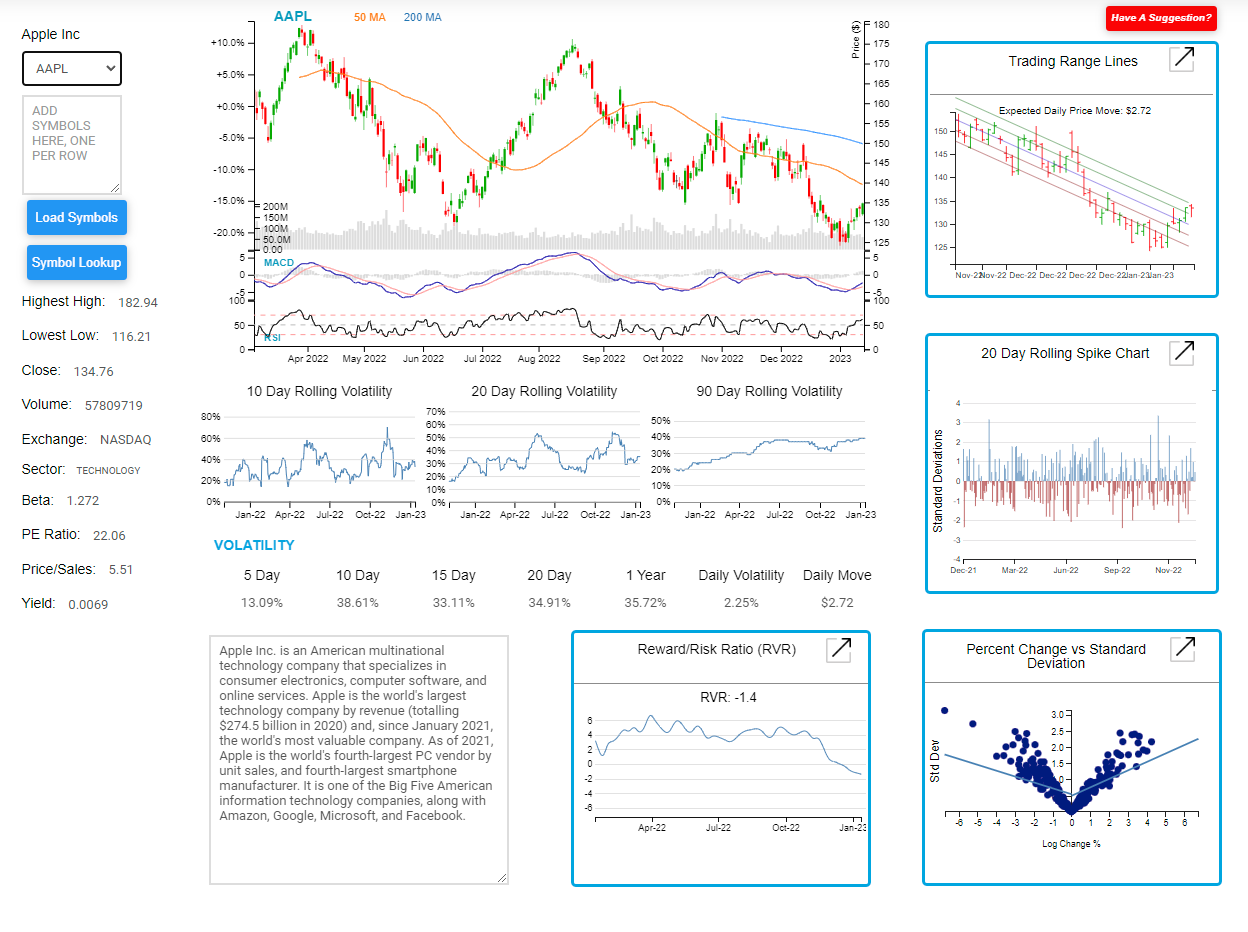
Volatility Analysis

Volatility is the cornerstone of profitability with the Tactical Trading System. Our advanced volatility analysis tools offer a clear view of a stock’s volatility across multiple time frames.

Here, you'll find charts that highlight unusual price spikes, a risk scatterplot, and our proprietary '5-Lines' linear regression. Over time, you’ll become adept at interpreting these visuals to determine if a stock is suitable for Tactical Trading.

Additionally, we provide a calculation of the stock's 'expected daily move,' which helps define the ideal Trade Range within the system.

Another proprietary indicator, the RVR (Reward vs Risk), evaluates whether a stock’s volatility aligns with its return performance, helping you assess the stock's profit potential.
Tactical Trading - simple stock trading system simulation

Simulation

This module lets you simulate how the Tactical Trading System would have performed based on your selected cycle parameters.

You can choose any time frame and adjust series numbers, shares per series, and trade range.

The simulation can run trade by trade or automatically over your chosen time frame.

It’s an excellent tool for testing the system through various price patterns to assess how well Tactical Trading would have performed.

Also included is the Simulation Optimizer, which runs multiple simulations to identify the most profitable Trading Range.

Tactical Trading - profitaable stock trading system trade

Trade

This is where you'll spend the majority of your time interacting with the Tactical Trading System. Here, you'll input your trade executions and receive the next set of orders.

In the 'Cycle Setup' module, you’ll have already selected the cycle parameters that now guide your trades in the Trade Module.

Tactical Trading - simple stock trading system dashboard

Dashboard

The 'Dashboard' is your central control room. Here, you'll find tables displaying all active and completed cycles, with profit and loss tracked for each.

All open orders are clearly listed, and the watch list allows you to monitor and receive updates on stocks you consider potential candidates for the system.

This is also where you'll find communication tools, including recent forum posts, feature requests, and announcements of important system upgrades.

Beat the Market, Mathematically: Achieve Consistent Profits with a Trusted, Data-Driven Stock Trading System

Beat the Market, Mathematically: Achieve Consistent Profits with a Trusted, Data-Driven Stock Trading System

Beat the Market, Mathematically:
Achieve Consistent Profits with a Trusted,
Data-Driven Stock Trading System

It’s widely recognized that buying and holding stocks generally delivers an average annual return of 10%, while professional traders often achieve returns of 20% to 30%. In contrast, the Tactical Trading system offers the potential for annualized returns of 100% to 300% over buy and hold — on the same stock, over the same time frame, with the same initial investment.

Profit outcomes depend on your chosen risk level, ranging from conservative to aggressive strategies. Key factors influencing maximum profitability include low strategic stock risk, minimal or no commissions, high trading range volatility, frequent transactions, short cycle durations, and favorable market conditions such as sideways or modest trends. Most notably, low margin requirements can significantly amplify returns.

Start Your 14-Day Free Trial and See Tactical Trading in Action!
Sign Up!

Start Your 14-Day Free Trial!
See Tactical Trading in Action!

Sign Up!

Samples Of Recently Concluded System Cycles

Put the table of closed cycles here
Ready To Get Started?
Start For Free
Easy Setup. No Commitment.